Mapping Portfolio
Page Navigation
Introduction
This page includes five mapping projects completed in GEO 678: Spatial Storytelling. Each map is a different perspective on water access and related water issues in India. These maps are extensions of my research on water access in India as an issue of human rights, development, and political discourse. As you move through each map, you may note the political and economic perspectives which foregrounds each map, but I encourage viewers to hold this focus in constant tension with the fact that water is a necessary part of human, plant, and animal existence. This page begins with preliminary two preliminary sketch maps before it moves into my reflexivity statement, and finally on to each map.
Sketch Maps
Sketch Map 1: Mapping Power Relations with Drinking Water
Sketch Map 2: Hauz Khas Water Project
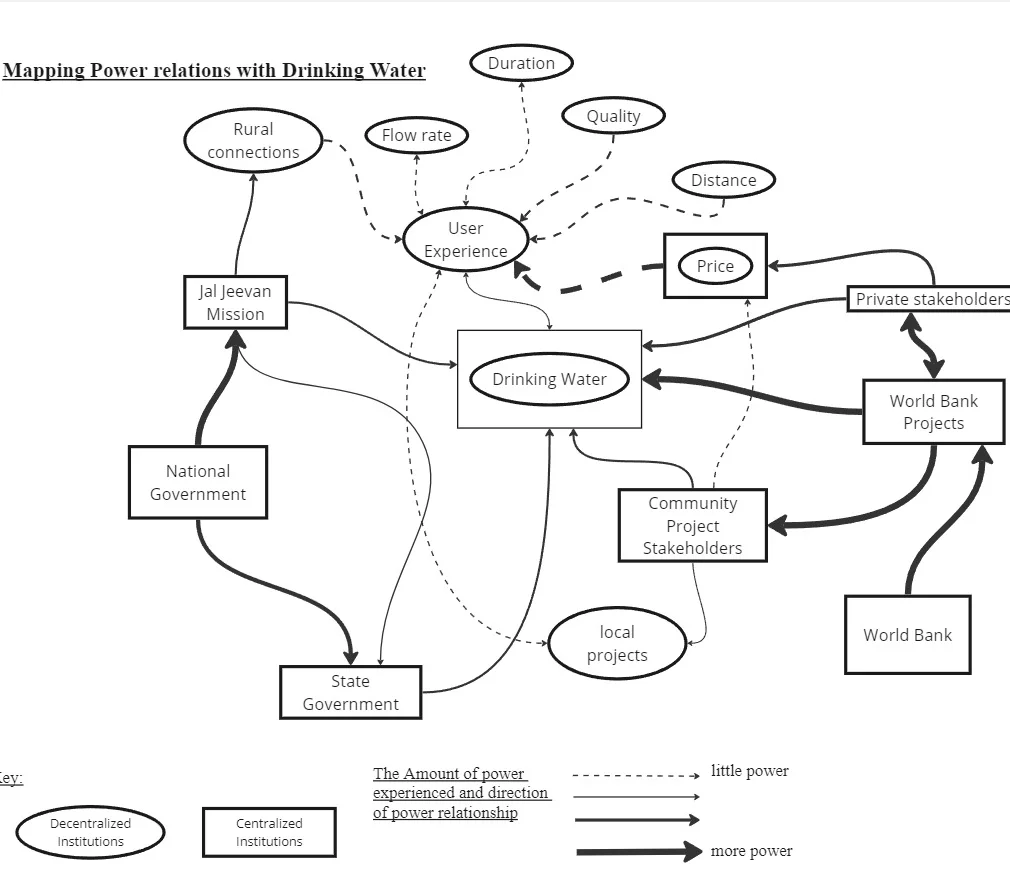
Sketch Map 1 depicts power relations between centralized institutions and decentralized experiences which alter drinking water access. To highlight the way in which power moves through and across various components that make up and attribute to drinking water access, I mapped out various varied scales of institutional actors, project types, and experience components related to drinking water access. The map depicts how large institutional actors like the World Bank and Indian Government tend to have the ability to exercise more power over various drinking water projects or other actors which then have narrower capabilities of exercising power over drinking water access. It also notes how some experiences related to drinking water like access itself and price are also captured within institutional structures adding layers to the way in which the state or user might view these elements. Taking a step back, this map also demonstrates the messiness of drinking water access and how interconnected and complex relations between elements of water access are especially when caught up in processes, flows, and a network of power.
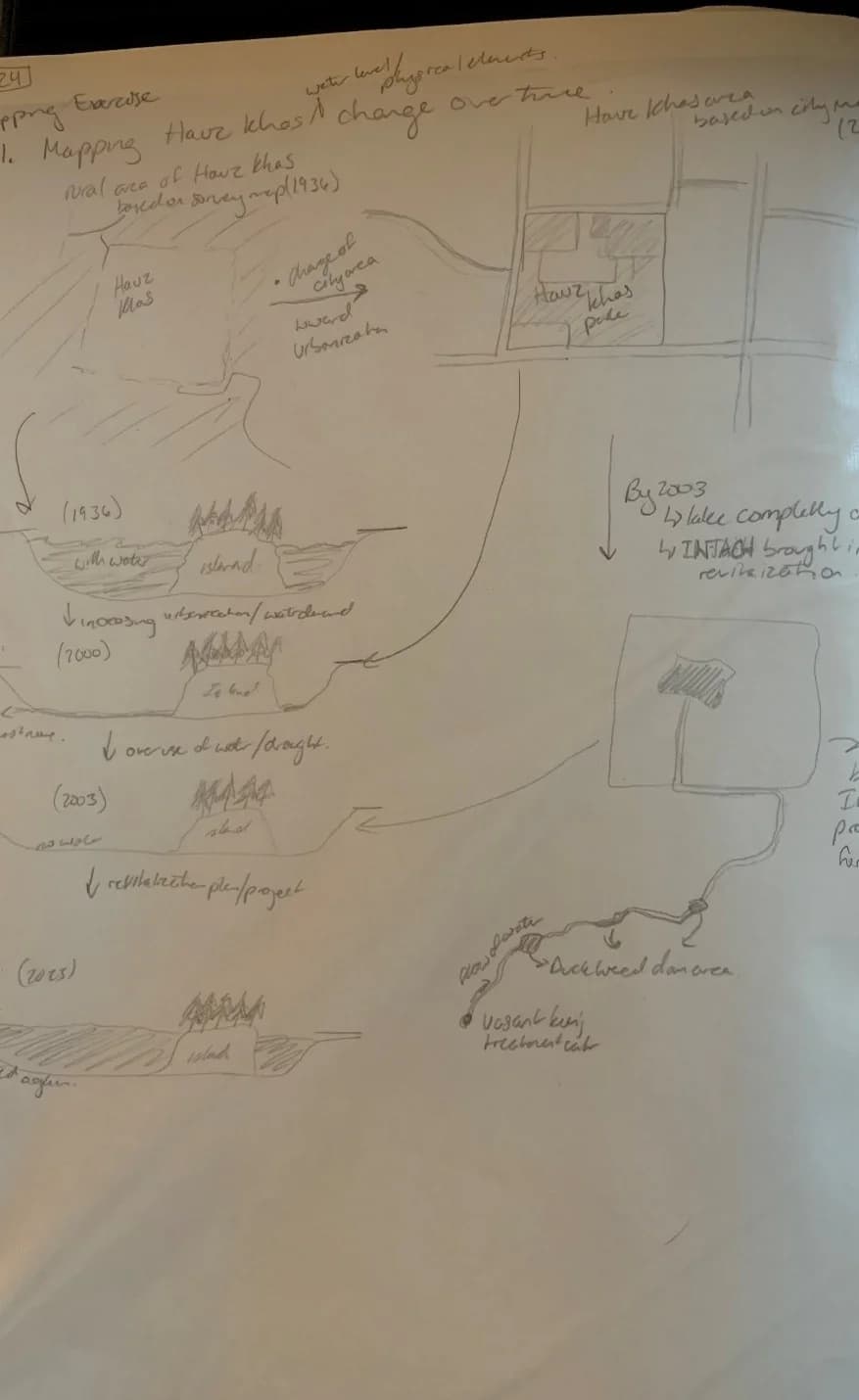
Sketch Map 2 depicts one narrow story of water access related to a project run by a local advocacy group in Delhi. It shows the progression of Hauz Khas lake situated in South-West Delhi which since 1936 has undergone rapid urbanization leading to drastic changes in the lake’s water table. Based on maps collected and presented by the advocacy group, the three top-down maps also demonstrate moments when the group became involved in restoring the lake and their proposed plan to revitalize it. The side view maps that correspond to each top-down map give viewers a means of seeing how rapidly water was lost and then restored to the lake. However, the map does not capture prominent issues around this water project including the diminishing aquifer based underneath this lake and part of the city which was replenished by this project. It fails to depict the issue of pollution which led partially to the drying of the lake and loss of ecology. Furthermore, it does not capture the returned issue of pollution due to failure to continue monitoring and implementing project components after the advocacy group transferred project responsibility to the city planning and development association. However, in failing to capture these elements of the project and changes to the lake, the map does demonstrate how political and environmental changes are often pushed to lower priority of project description and implementation despite having real impact on the project and outcomes.
Reflexivity Statement
As an academic researcher born and raised in the United States it is critical to reflect on my position in my research related to water access in India. An important element is my position as a white woman from a middle-class background who has had the opportunity to attend higher education and am working in a space of immense privilege that so often reproduces and upholds structures of power. Specifically, this central element of reflection as I conduct research in India speaking with community members and locals who are often marginalized and disenfranchised within the context of India. As a Caucasian academic from the U.S., I am inherently entering a power dynamic every time I engage in community-based research. This is especially true given India’s former colonization by Britain left lasting impacts on social structures and power hierarchies that often position me in a place of power over the communities I interact with. As a woman, this is slightly improved in the context of gender relations but creates its own complexities that I must be mindful including speaking with young men, women in highly traditional family structures, and speaking with government officials. One way in which I engage with both of these elements in an attempt to diffuse the power structures embedded in interactions is to begin by allowing participants to ask questions of me and my research. This enables an initial flow of information that the participant can control. In addition to this, I always make it clear at the start, throughout my qualitative data collection process, and at the end that any participant is welcome to withdraw portions or all of their statements from my research project at any time regardless of where I am in the process of research or publication. I also intend to share back my findings with participants prior to publication to give them an opportunity to make suggestions, indicate where I may have misrepresented them, and another option for withdrawing their statements.
Another realm of positionality is related to my work with development organizations and professionals. While in attendance at development organization meetings or interviewing professionals I enter into another space of inequal power dynamics, but one where power and positionality are much more diffuse and obscured. In these spaces I am often seen as an equal given my status as an academic, but I am also occasionally automatically placed in a position below from which I need to be mindful of how I navigate the power dynamic which places me at a slight disadvantage in data collection. More importantly, these spaces create power dynamics even without individuals or communities involved. I often must navigate and be mindful of instances where attempts are made to diminish or marginalize experiences of the communities in India with which I work. In these moments, my power as a researcher also becomes evident and it is critical even in moments when I do not have the ability to combat these narratives, that I reflect on them and include them in my analysis to ensure I am considering my own and participant biases in my research. Understanding, reflecting on, and embedding practices of questioning my own positionality and power in spaces of my research is a crucial part of my work and requires on going and diligent practice.
Map 1: Household Drinking Water Access Compared to Previous and Existing World Bank Water Supply Projects in India
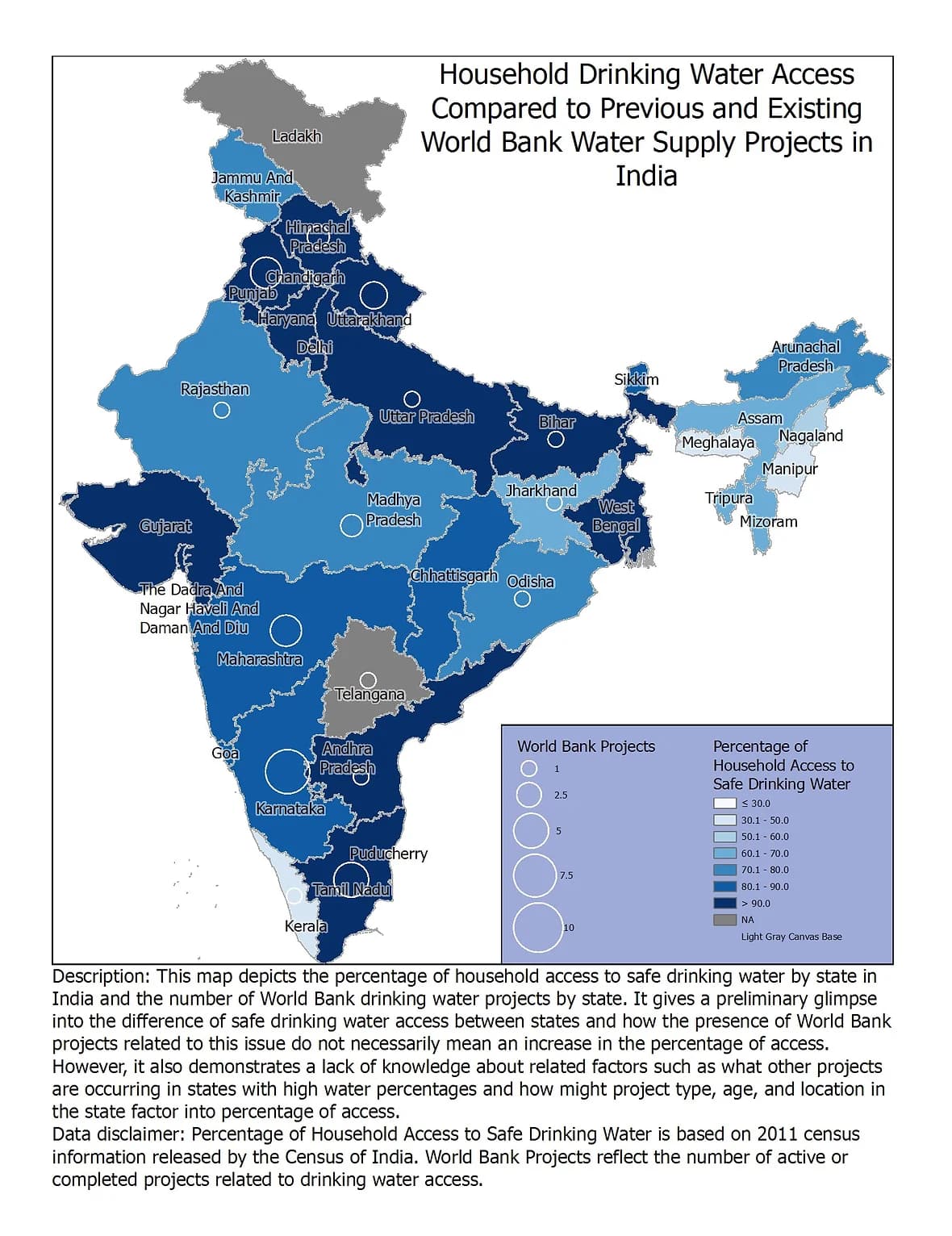
This map represents household access to safe drinking water in India against the number of World Bank drinking water projects. It operates as both an initial introduction to what household drinking water access looks like in terms of percentage and where the World Bank has funded drinking water projects. However, a closer inspection of the data source disclaimer and circles indicates that this picture is largely out of data and does not provide an updated view of water access in India and the hollow circles raise questions about where the World Bank has helped implement these projects and the full goals of them. While the data becomes an obstacle it is also operates to represent the lack of accurate data on water issues in India and that any data or map portraying water access should be questioned regarding its source and accuracy. The hollow circles also foreground a critique of World Bank projects as being vague and difficult to appraise for location, success, and intention.
Map 2: Stories of Climate Change: The Impact of Increasing Ocean Levels on Fresh Water Access in Chellenam, India
This map depicts the story of declining fresh water access as ocean levels rise and increase water saliency in Chellenam, India. I utilized the multidimensional mapping technique that Margaret Pearce and Michael Hermann outline in their 2010 article: "Mapping Champlain's Travels: Restorative Techniques for Historical Cartography" as a guide to building this map. "Stories of Climate Change" follows a discussion of resident experiences with increasing water saliency as climate change leads to higher ocean levels and makes local freshwater sources nonviable for human use. It weaves across scales of analysis from local to international to highlight the role climate change has on every day lives and the struggle for water access. It positions both my own analysis of water access issues in Chellenam, India from news sources along side quotes from residents in the area.
Map 3: Tension over Water Rights in the Indus River Valley
This mapping project utilizes ArcGIS Story Maps to create a scrolling story which blends visual elements with a narrative discussion of the tension over water in the Indus River Valley. The project outlines the history of the Indus River Valley, the rise of dams globally, and in India before discussing the implications of the Indus Waters Treaty of 1960. It provides a walk through for viewers to consider the history and modern presence of dams along side the tension over fresh water rivers which are relied on by millions of people in India and Pakistan as a source of water.
Map 4: Mapping the "Miracle Water Village"
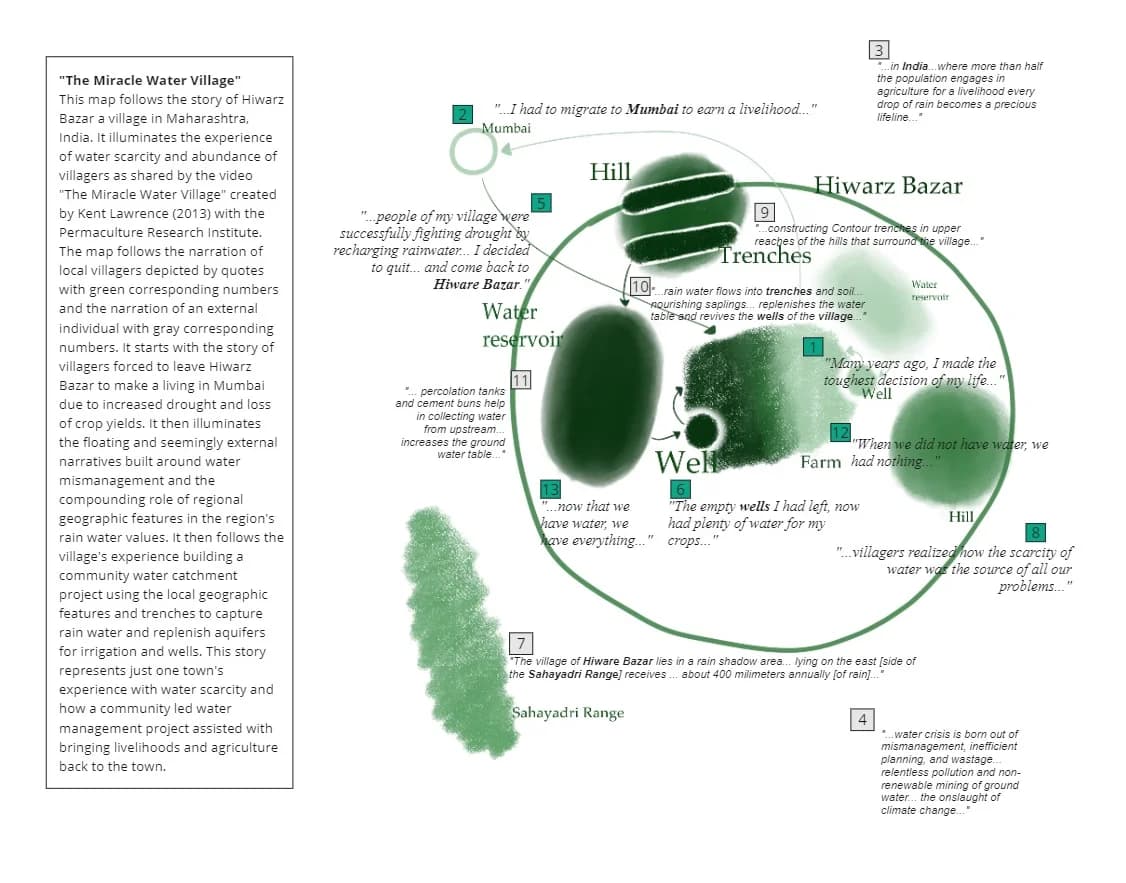
This map utilizes the topology mapping technique outlined by Levi Westerveld and Anne Knowles in their 2020 article "Loosening the grid: topology as the basis for a more inclusive GIS" to share the story of a community water management project in Hiwarz Bazar, India. The map follows the story of water access in Hiwarz Bazar and the experience of local farmers whom were forced to migrate for work in Mumbai due to crop loss with rising drought conditions, and their subsequent return to town after successful implementation of a community water project. The map utilizes colors, shading, and quotes to depict the experiences of these farmers prior too, during, and after the projects implementation. It centers the very real and intense experiences of water users in India especially when water plays a central role in economic livelihoods.
Map 5: Border Tension: The Fight for Water Rights under the Indus Waters Treaty of 1960
This mapping project utilizes a mapping technique laid out by Meghan Kelly in her 2019 article "Mapping Syrian Refugee Border Crossing: A Feminist Approach" to share the varied perspectives of borders related to the Indus Waters Treaty of 1960. The project follows an atlas style map which gives the perspective of India, Pakistan, and the World Bank related to river flow rates across the Indian/Pakistan border. It begins first with an introduction to the method before showing border perspectives related to the portion of the treaty giving Pakistan control of the Western Rivers, and the then shifts to consider the perspectives of the treaty which give control of the Eastern Rivers to India. Critically, this mapping project reflects on the opposing views of border tension over river flows under the Indus Waters Treaty. It looks at the way the treaty is viewed by the World Bank, India, and Pakistan depending on their own positionality and power over particular rivers and critiques the notion that this treaty has drawn explicit peace to the region over river rights.
Dedication: This page and each of the five mapping projects presented here are dedicated to Jack, who was always a source of inspiration and support in all my academic and mapping endeavors related to and beyond my research.
BROOKLYN MONTGOMERY
brmontgo@syr.edu
Department of Geography and the Environment Maxwell School of Citizenship and Public Affairs
048 Eggers Hall Syracuse, New York 13244
Webiste made by Zach Mosher | zmosher4@gmail.com